
The United Nations has revised downward India's economic growth forecast for 2026 to 6.4 per cent from an earlier 6.6 per cent, attributing the change to global uncertainties and economic shocks stemming from the ongoing West Asia crisis.

Following an examination and discussions held in the aftermath of the United States' decision to withdraw from dozens of international organisations, Israel's Minister of Foreign Affairs, Gideon Sa'ar, has decided that Jerusalem will immediately sever all contact with several United Nations agencies and international bodies, citing what the government described as persistent bias, politicisation and actions hostile to Israel.

President Donald Trump has withdrawn the United States from over 60 international organisations, including United Nations bodies and the India-France-led International Solar Alliance, calling the institutions 'redundant' and 'contrary' to America's interests.

External Affairs Minister S Jaishankar affirms India's self-determined and 'unstoppable' rise, emphasising the nation's strategic growth and role in the Indian Ocean region amid evolving global dynamics.

The Dhurandhar movies will undoubtedly shape the minds of the audience much more than news reports, court investigations, books and documentaries. But it is worth remembering that Pakistan's irridentist claims against India's national security have succeeded due to strategic planning, diplomacy, and the unsung heroines and heroes across government agencies, not due to a single maverick leader, points out Shweta Desai.But it is worth to remember that Pakistan's irredentist claims against India's national security have succeeded due to strategic planning, diplomacy, and the unsung heroines and heroes across government agencies -- not a single maverick, points out Shweta Desai.

China has reaffirmed its territorial claims over the Shaksgam Valley, dismissing India's objections to infrastructure projects in the area. The Chinese Foreign Ministry spokesperson stated that the territory is part of China and its activities there are beyond reproach.

Iran has formally appealed to the United Nations Security Council and the UN Secretary-General, accusing the United States of inciting violence, interfering in Iran's internal affairs, and threatening military action, according to an official letter circulated by Iran's Permanent Mission to the UN.

Earlier in the day, the ministry of external affairs "strongly advised" Indians to avoid travel to Iran until further notice, amid rising tensions and protests in the Islamic Republic.

The question is no longer whether the war will expand. It has. The next few days will tell us whether the war stabilises around Hormuz or whether the Strait itself becomes the trigger for a far larger rupture. What to watch for over the next 48 hours is simple: Any move by the US toward direct naval control of the Strait; any credible Iranian attempt to disrupt or mine shipping lanes and, critically, whether energy infrastructure in the Gulf continues to be targeted.If those lines are crossed in tandem, the war will no longer be containable within the region.

The LPG squeeze on India's restaurant sector is the quotidian face of a deeper crisis.

Iran is fighting a different war: Older, slower, and in some ways more dangerous. Iran doesn't need to shoot down an F/A-18. It only needs to make the Strait of Hormuz feel dangerous long enough for insurance markets, shipping companies, and oil futures traders to do the rest. Prem Panicker continues his must-read daily blog on the war in the Middle East.

'It is best to remain vigilant. Tarique Rahman arranged arms smuggling to Indian insurgent groups.' 'He has criticised India for sheltering Sheikh Hasina, but has also sought India's support.'
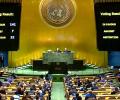
India abstained from a UN General Assembly vote on a resolution regarding Afghanistan, citing the need for a balanced approach that combines incentives and disincentives, and calling for new initiatives to address the humanitarian crisis.

'To suddenly give the impression of taking a position that is hostile to Iran, or, at least, not friendly to Iran, is not a good thing.'

Afghan Foreign Minister Amir Khan Muttaqi arrived in New Delhi for a six-day visit, marking the first high-level trip from Kabul since the Taliban's takeover. He is scheduled to meet with Indian officials to discuss bilateral relations and regional issues.

Left parties on Saturday denounced the United States for attacking Venezuela and capturing its President Nicholas Maduro, with Communist Party of India-Marxist general secretary M A Baby terming the nighttime military action an 'act of international terrorism by US-led imperialism'.

What we are watching is something different: A fog manufactured and maintained by the people who started the war, so that the question of why it was started never has to be answered, observes Prem Panicker in his must read blog on the war in the Middle East.
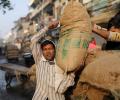
India's economic growth forecast for 2025 has been revised downward to 6.3 per cent, and despite a projected moderation, the country remains one of the fastest-growing large economies, supported by resilient consumption and government spending, the United Nations has said.
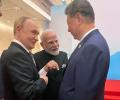
The relations between New Delhi and Washington are on a downturn after Trump doubled tariffs on Indian goods to a whopping 50 per cent, including a 25 per cent additional duties for India's purchase of Russian crude oil.
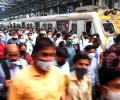
India's population is projected to peak in the early 2060s at about 1.7 billion and then decline by 12 per cent, but the country will remain the world's most populous throughout the century, the United Nations has said.

Deputy Commissioner for the New York City Mayor's Office for International Affairs Dilip Chauhan made the announcement in the presence of Minister of State for Social Justice and Empowerment Dr Ramdas Athawale, who delivered the keynote address at a special event organised at the UN headquarters on Monday to commemorate Dr Ambedkar's 134th birth anniversary.
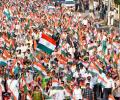
The next Census' findings will help identify the extent of India's ageing population and vulnerability levels.

While growth in India and China is likely to remain robust, the rest of the world risks falling back into recession if developed countries embark prematurely on fiscal austerity measures, says a United Nations report, released in New York on Thursday.
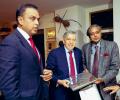
All-party parliamentary delegations on Friday met leaders and diplomats from several countries to galvanise international action against terrorists and decisively counter the tactics of those who perpetrate, support and sponsor cross-border terror activities against India.

He said despite efforts by the UN, the threat of terrorism is only growing and expanding, particularly in Asia and Africa.

The United Nations has projected a growth of 7.9 per cent for India in the current fiscal as it hailed the country along with China for leading developing nations to recovery from the worst economic downturn since World War II.
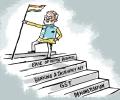
As the Ukraine conflict impacts the global GDP, India is projected to grow by 6.4 per cent in 2022, slower than the last year's 8.8 per cent but still the fastest-growing major economy, with higher inflationary pressures and uneven recovery of the labour market curbing private consumption and investment, according to a UN report. The UN Department of Economic and Social Affairs said in its World Economic Situation and Prospects (WESP) report released on Wednesday that the war in Ukraine has upended the fragile economic recovery from the pandemic, triggering a devastating humanitarian crisis in Europe, increasing food and commodity prices and globally exacerbating inflationary pressures. The global economy is now projected to grow by only 3.1 per cent in 2022, down from the 4.0 per cent growth forecast released in January 2022.
In January, the UN had forecast that the world economy would shrink 0.5 per cent this year. The report predicted that with a coordinated, development-oriented policy scenario, the world economy would recover to an annual growth of 4-5 per cent in 2010-2015, led by a robust growth of 7 per cent a year in developing nations.

With nearly 100 countries closing national borders during the past month, the movement of people and tourism flows have come to a screeching halt. The contraction could be even higher if governments fail to provide income support and help boost consumer spending.
Women hold the key to eradicating poverty worldwide, but must be supported in their efforts to lead families, societies and nations towards prosperity, senior United Nations officials told an inter-governmental meeting on Tuesday.\n\n\n\n
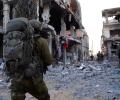
'The message that India has conveyed since the start of this conflict is clear and consistent. It is important to prevent escalation to ensure continued delivery of humanitarian aid and to work towards an early restoration of peace and stability. A peaceful resolution of the conflict through dialogue and diplomacy is the only way forward'

India's economy is forecast to grow at 4.8 per cent in 2013, down 1.3 per cent from its earlier projection, the UN's World Economic Situation and Prospects 2014 report said.
Senior United Nations experts have said that lack of investment in agriculture over a long period of time and the use of precious natural resources for bio-fuel production have also contributed to the current food crisis. The use of crops for bio-fuel production had also contributed to the worldwide rise in food prices, since it meant that a part of our natural resources had to be diverted away from the production of food crops. The experts were talking in a conference in NY.

The decision is expected to provide a push for their development in healthcare, cultural identity, education, financial matters, skill development and women empowerment among others, the Chief Minister's Office said in a statement.

'In India, a deadly wave of infection with the Delta variant stole 240,000 lives between April and June and disrupted economic recovery. Similar episodes could take place in the near term,' said the report.
Addressing the Committee for Development Policy, Sha Zukang, under-secretary-general for economic and social affairs, said the worst economic crises since the great depression have thrown many more people into poverty.
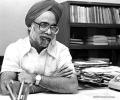
What stood out in his 15-year journey as a member of the political executive at the Centre was his glowing record as India's most successful and effective finance minister. Both as prime minister and finance minister, he understood the importance of gradualism, except when the economy or the polity was in a crisis.
Acting on his pledge to achieve continuity with change, United Nations Secretary-General Ban Ki-moon has named four new senior officials to his Cabinet while retaining a dozen others.

India will see a gradual growth acceleration with its GDP expected to reach 5.9 per cent this year.

Times have changed, situations have changed, but the basic nature of superpower geo-politics remains the same and so also India's diplomacy -- call it non-alignment, strategic autonomy or neutrality; it all depends on the time scale, notes Rup Narayan Das.
